
REVIEW · TROUBLES HISTORY & PEACE PROCESS TOURS
Belfast Troubles Tour: Walls and Bridges
Belfast’s walls explain the city. This walking tour connects big Belfast landmarks with the real story of the Troubles, guided by a Belfast native, with private-tour attention and Peace Wall context that goes beyond sightseeing. I especially love how it starts with the polished awe of Belfast City Hall, then moves quickly into street-level history you can actually see and photograph.
One thing to know first: this is not a fluffy history walk. The tour includes graphic content and it is designed for adults and teens 14 and up, plus there is a solid amount of walking, so you’ll want a moderate fitness level.
In This Review
- Key things that make this walk worth your time
- Walls and Bridges, and why a walking tour works in Belfast
- Starting at Belfast City Hall: marble, stained glass, and a quick wow factor
- Dan George’s sculpture: Celtic design and Belfast’s public identity
- International Wall of Murals near the Peace Walls: messages in paint
- The Peace Wall: photographing responsibly, understanding the 16 meters
- Albert Clock Tower: the leaning landmark and the film connection
- Cathedral Quarter: cobblestones, murals, pubs, and a newer Belfast
- First Presbyterian Church: history that complicates the easy story
- Belfast Entries: the narrow passageways you would miss without a guide
- Pace, comfort, and how to hear your guide clearly
- Value check: what $33.29 gets you in Belfast
- Who this tour fits best, and who might want a different plan
- Should you book Belfast Troubles Tour: Walls and Bridges
Key things that make this walk worth your time
- Private guide focus keeps questions from getting lost in a crowd, with a small group size (max 16).
- City Hall interior details include Italian marble and dramatic stained glass, with free entry time to look around.
- Peace Wall photos with context help you understand what the 16-meter height (and safety mesh) means.
- Landmark-to-neighborhood flow links the Troubles story to modern Belfast at the Cathedral Quarter.
- Hear-every-word support with headsets, so street noise does not ruin the story.
- Ends in the Entries so you finish with Belfast’s older maze-like street charm, not just memorials.
Other Troubles history tours, reviewed the same way
Walls and Bridges, and why a walking tour works in Belfast
The phrase Walls and Bridges sounds poetic, but it is also practical. In Belfast, physical boundaries shaped where people walked, shopped, worked, and even where they felt safe. This tour uses that idea in a smart way. You start with landmark Belfast, then you move into the places where the walls became part of everyday life, and then you cross back toward neighborhoods that show where the city goes from here.
What I like most is that the story is not built like a slideshow. You are on the pavement, standing at the angles and sightlines where history becomes visible. That is why a walking format matters. It also helps that your guide can point things out in real time, instead of asking you to imagine them from a distance.
Guides on this tour have a consistent approach, mixing straight facts with humor and personal perspective. Names like Arthur and Steve come up in guide stories, and the key takeaway from their style is simple: you get context first, then details, and the tone stays balanced even when the content is heavy.
Starting at Belfast City Hall: marble, stained glass, and a quick wow factor
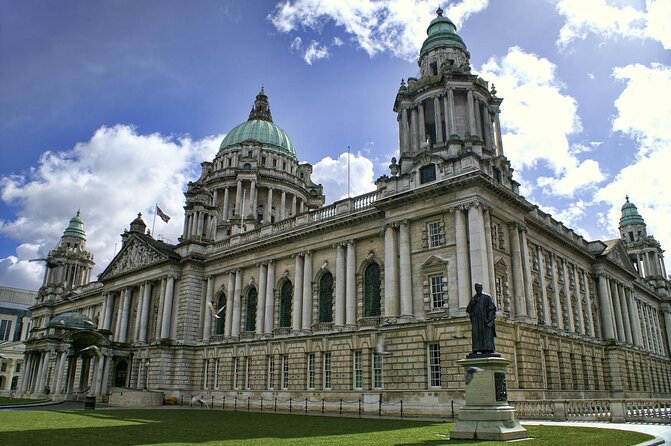
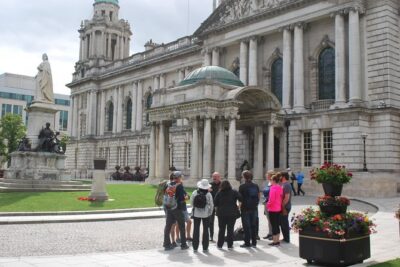
You meet at Belfast City Hall, and right away you get a sense of why this city takes pride in its architecture. The dome rises about 174 feet, and the interior is not just pretty. It is built to impress, with several types of marble including Italian options and Cippilino marble from Greece, plus stained glass windows that are genuinely worth slowing down for.
You get free time to go inside, and that matters for value. A lot of walking history tours keep you outside the whole time, but here you get a real interior moment early in the tour. It sets the tone too. Before you hit the tougher subject matter, you see how much Belfast expresses itself through stone, design, and public buildings.
Potential drawback at the start: if you rush past City Hall too fast, you might miss what the guide is using it to frame. Give yourself those ten minutes. Look up at the dome. Take in the marble. Then you will be ready for the shift to murals and walls.
Dan George’s sculpture: Celtic design and Belfast’s public identity
After City Hall, you move to a marvellous modern sculpture by Dan George in the city centre. It is a piece that blends traditional Celtic design with engineering, industry, and community themes. The point of this stop is not to admire one artwork and move on. It is a bridge from the official face of Belfast to the working life and civic character that shaped how communities developed.
This is a short stop, so treat it like a pause button. Stand, look at how the sculpture’s motifs connect to Belfast’s identity, and then listen for how your guide links it to the larger story. If you’re the type who likes history that ties into daily life, this is where the tour starts to feel personal.
- Titanic Belfast Entrance Ticket: Titanic Visitor Experience Including SS Nomadic
★ 4.5 · 3,698 reviews




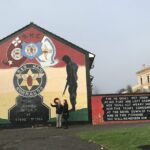
International Wall of Murals near the Peace Walls: messages in paint
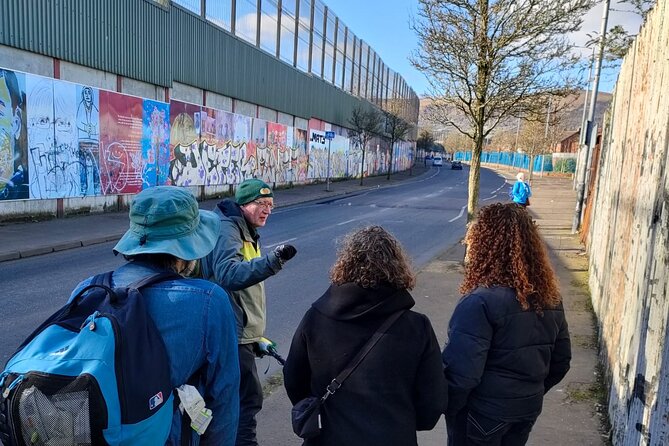
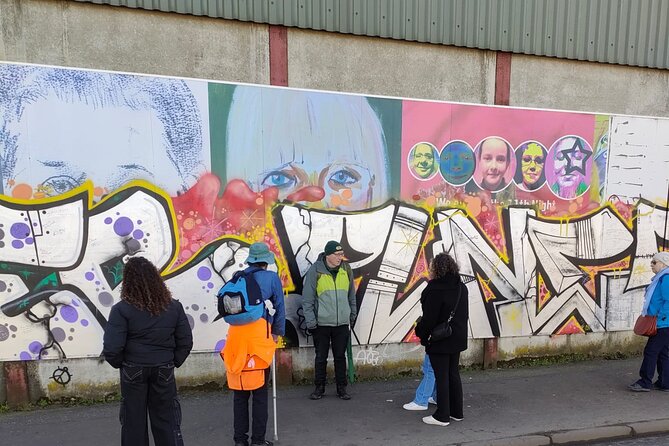
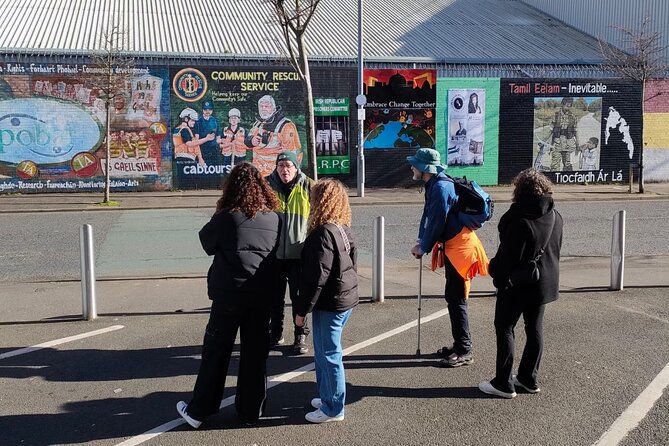
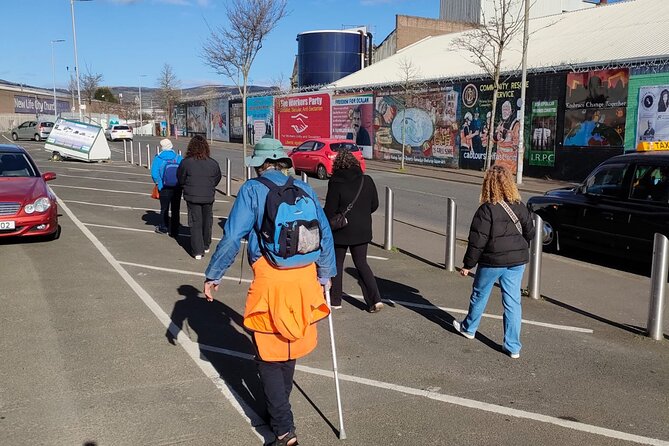
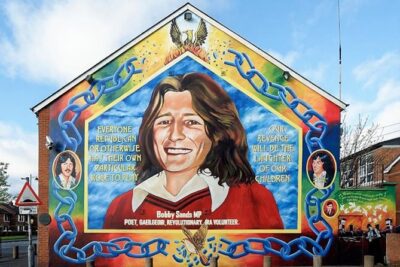
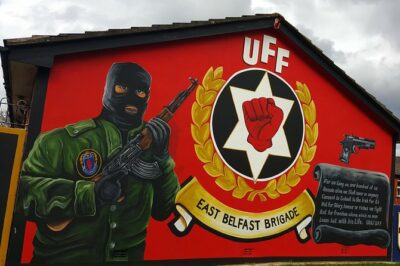
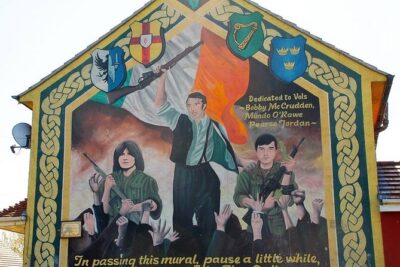
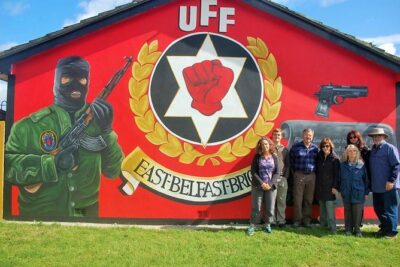
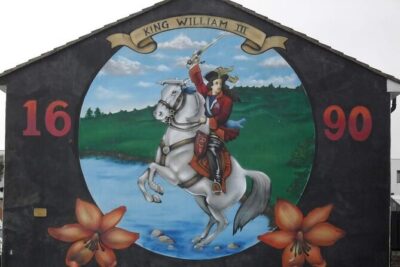
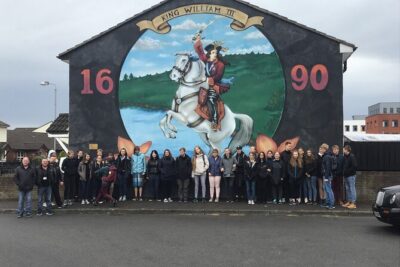
Next you head to the International Wall of Murals by Divis Street, close to the Peace Walls. Murals here are not just decoration. They act like public communication, reflecting what people want remembered and what they want to say to each other.
You get time to see the murals and then the guide provides context. That matters because a mural can look like a simple graphic if you only skim it. With explanation, you start noticing patterns, symbols, and how different messages are placed and layered over time.
A practical tip: take your photos, but also step back now and then. Standing close gives you detail, and stepping back helps you understand how the wall sits in the neighborhood.
The Peace Wall: photographing responsibly, understanding the 16 meters
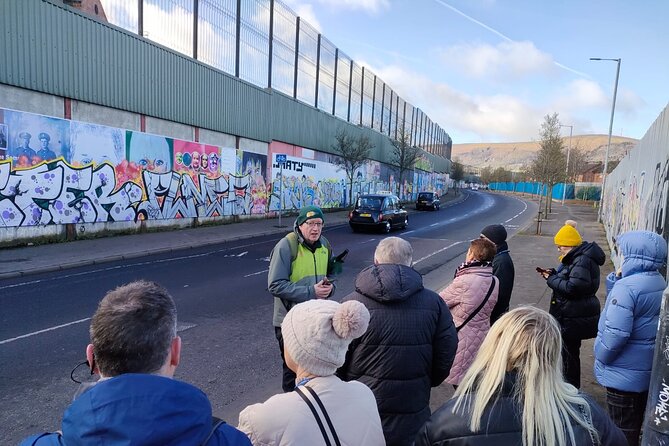
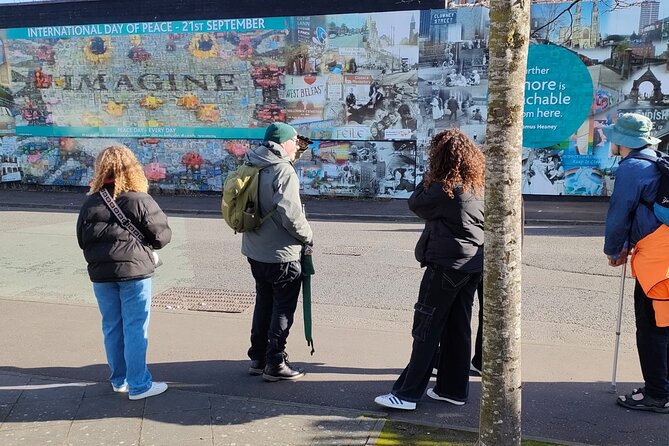
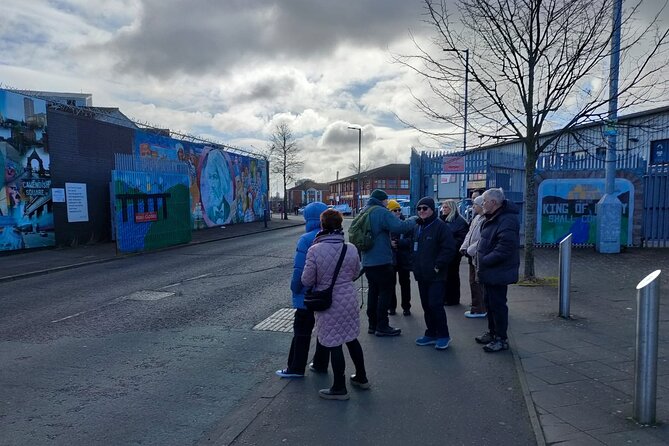
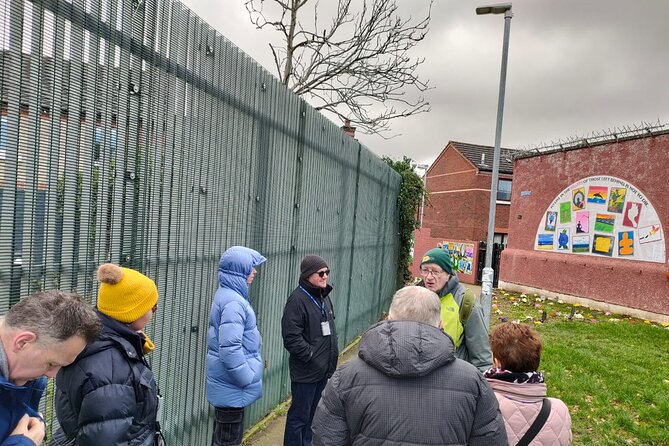
This is the emotional core of the walk. The Peace Wall divides two communities, and it is about 16 metres high. It is topped with mesh meant to reduce the risk from petrol bombs. You will also hear the practical reasons the wall exists, not just the political slogans attached to it.
You get time to photograph and to examine the wall up close. It helps that the guide does not just recite dates. The explanations are meant to help you understand how people experience separation day to day, and how safety measures become part of the landscape.
This is the stop where a lot of people feel the weight of the tour’s content. It is also where the tour earns its strong reviews for being balanced and human. If your brain tends to shut down when stories get graphic, use this time to slow your breathing and focus on what you can handle: the facts, the geography, and the why behind it.
Albert Clock Tower: the leaning landmark and the film connection
After the Peace Wall area, you head toward the Albert Memorial Clock Tower. It is Belfast’s own leaning tower, built at the town’s establishment crossing point. The tower is about 113 feet tall and leans roughly 4 feet off perpendicular.
It also has a film footprint. The guide points out its connection to the iconic noir film Odd Man Out, starring James Mason. Even if you have not seen the movie, this kind of pop-culture touch helps the story stick. It connects a political geography moment to something broader in how Belfast has been represented.
This is a short stop, around five minutes, so your best move is to choose one viewpoint and take it in. Notice the lean first, then let the guide layer in the history behind why the tower is where it is.
Cathedral Quarter: cobblestones, murals, pubs, and a newer Belfast
Then you arrive in the Cathedral Quarter, which is where the tour shifts from dividing lines to city life. You walk through an area known for colourful street artwork, lots of pub and restaurant energy, and cobbled stones that feel like old Belfast on foot.
One detail I like here is that it is not only about current nightlife. The guide connects the neighborhood to the city’s cultural side, including where significant rock events happened. That helps you understand Belfast as more than a conflict map.
If you are hungry, this is a good zone to plan for later on. You will feel ready to move on, talk, and maybe grab a coffee or something simple to eat after the heavier stops.
First Presbyterian Church: history that complicates the easy story
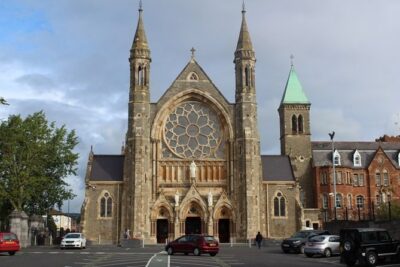
Near the end, you visit First Presbyterian Church, a building that feels like it is still holding onto the late 1700s. It dates from 1783, and it is known for an elliptical shape. The guide discusses John Wesley preaching from the pulpit, which adds another layer beyond a neat religion-versus-religion storyline.
This is also where the tour’s balance shows up clearly. The guide talks about community members pushing for civil and religious freedoms. The message is not that everyone was the same, or that conflict was simple. It is that people in Belfast history did not only move along one stereotype.
You get time to explore and take photographs, and the church stop is included. It is about ten minutes, and it is a strong finishing rhythm: you move from hard separation imagery back to a place of debate, belief, and civic identity.
Belfast Entries: the narrow passageways you would miss without a guide
To close, you walk through the Belfast Entries, historic passageways that many visitors would never find on their own. This stop is short, but it lands well because the Entries feel like an old city still working in miniature. Narrow paths, older street textures, and the sense that Belfast has layers you only notice when someone guides your feet.
You are shown sights tied to revolution, intrigue, and pubs. It sounds like storytelling theater, but the effect is real. You get a final impression of how Belfast communicates history in everyday details, not just official monuments.
The tour ends back near Rosemary Street, still close to where you started at City Hall, which makes it easy to continue your day without a long commute.
Pace, comfort, and how to hear your guide clearly
This is a walking tour with multiple short stops. Plan on about 2 hours 40 minutes to 3 hours in practice, depending on how often you pause for photos and questions. Reviews often emphasize that the time moves quickly, but do not assume it will feel effortless. You are still walking, and some parts can be emotionally intense.
Wear comfortable shoes. Bring a light layer, because Belfast weather can shift. Also, you will benefit from headsets. Several guide experiences note that headsets help you hear everything clearly, even while you’re standing near streets and crowds.
If you have mobility limits, you should check your own comfort with a city-center walking route. The tour asks for moderate physical fitness, and it is not built as a sit-and-watch style outing.
Value check: what $33.29 gets you in Belfast
At around $33.29 per person, the value is mostly in three places:
- You pay for a guide who turns locations into understanding. The Peace Wall and murals are where a guide makes the difference. Without context, you might see a wall and move on. With context, you see why the wall mattered and what it changed.
- You get built-in stops with free access. City Hall time is free, and the other listed landmarks also come with free admission time. The one paid entry included is First Presbyterian Church, so your money is not just going toward walking and chat.
- Small-group feel helps the tour stay focused. Even with a maximum group size of 16, the private-tour setup means your questions are more likely to get answered directly.
If you want a simple sightseeing loop, this might feel too story-heavy. But if you want Belfast with context, this is a good deal.
Who this tour fits best, and who might want a different plan
This is a strong choice if you:
- care about modern history and how it shapes neighborhoods
- like guides who can balance hard facts with humor
- want a route that includes both Troubles context and major Belfast landmarks
- want a walking format that helps you visually understand boundaries
This may be less ideal if you:
- are traveling with younger kids
- want only upbeat, casual content
- are sensitive to graphic descriptions
- prefer long museum-style stops with minimal walking
The tour also has a minimum age of 14, and it is not aimed at children.
Should you book Belfast Troubles Tour: Walls and Bridges
I would book it if you are ready to do more than scratch the surface. This walk gives you Belfast’s landmarks, but it spends its real energy where history is still visible. The Peace Wall stop, the murals near Divis Street, and the way the guide links them to Belfast’s civic and cultural identity make it feel like a complete story arc, not just a list of dark places.
If you are unsure, here is the simplest decision rule: if you can handle heavy, sometimes graphic history and you want a balanced guide-led explanation in the streets, this tour is for you. If you want a relaxed day with no difficult subject matter, pick a different Belfast route and save this for a time when you can absorb it fully.
Other Tours We Have Been On
- Cab Tours Belfast Famous Black Taxi Tours
★ 5.0 · 3,633 reviews - A History of Terror – Belfast City Centre Walking Tour
★ 5.0 · 2,883 reviews - Game of Thrones and Giant’s Causeway Full-Day Tour from Belfast
★ 5.0 · 2,291 reviews - Private Black Taxi Belfast City Tour
★ 5.0 · 2,188 reviews - City Sightseeing Belfast Hop-On Hop-Off Bus Tour
★ 4.5 · 2,012 reviews
More From the Northern Ireland Pile
- Titanic Belfast Entrance Ticket: Titanic Visitor Experience Including SS Nomadic
★ 4.5 · 3,698 reviews - Cab Tours Belfast Famous Black Taxi Tours
★ 5.0 · 3,633 reviews - A History of Terror – Belfast City Centre Walking Tour
★ 5.0 · 2,883 reviews - Game of Thrones and Giant’s Causeway Full-Day Tour from Belfast
★ 5.0 · 2,291 reviews - Private Black Taxi Belfast City Tour
★ 5.0 · 2,188 reviews
The Troubles, Told Firsthand
- A History of Terror – Belfast City Centre Walking Tour
★ 5.0 · 2,883 reviews - Belfast’s Political Mural Taxi Tour
★ 5.0 · 1,180 reviews - Belfast Political Tour-Conflicting Stories Walking Tour
★ 4.5 · 459 reviews - Political Taxi Tour Belfast (1-7 People)
★ 5.0 · 294 reviews - 2 Hour Private Belfast Taxi Cab Tour of Troubles & Peace walls
★ 5.0 · 240 reviews
More reviews from around the north
- Belfast history of terror & mural 1 hr express private taxi tour★ 5.0 · 3 reviews
- Game of Thrones scene location inc Giants causeway from Belfast★ 5.0 · 3 reviews
- Experience the Antrim Coast and the Land of Giants – Private Tour★ 5.0 · 3 reviews
- Giants Causeway Tour From Belfast including Game of thrones sites★ 5.0 · 3 reviews
- Private Coast Tour in Belfast★ 5.0 · 3 reviews
- Belfast to Dublin Transfer★ 5.0 · 3 reviews
Troubles History & Peace Process Tours, in full.
 ★ 5.0A History of Terror – Belfast City Centre Walking TourFrom $362,883 reviews
 ★ 5.0Belfast’s Political Mural Taxi TourFrom $481,180 reviews
 ★ 4.5Belfast Political Tour-Conflicting Stories Walking TourFrom $36459 reviews
 ★ 5.0Political Taxi Tour Belfast (1-7 People)From $51294 reviews
 ★ 5.02 Hour Private Belfast Taxi Cab Tour of Troubles & Peace wallsFrom $117240 reviews
 ★ 5.02 hours Belfast Original Drivers The Troubles Black Taxi TourFrom $101227 reviews
 ★ 5.0Private Political History & Murals Tour BelfastFrom $76182 reviews
 ★ 5.0Black Taxi Tour and Crumlin Road Gaol tour ComboFrom $152170 reviews
Appears in